

Start with the required thrust per motor, then check a tested motor–propeller–voltage combination at both hover and target thrust. A motor’s KV alone does not tell you how much thrust it will produce.
1. Calculate hover and target thrust separately
Include the frame, battery, payload and electronics in the all-up mass. For equal load sharing with vertical, parallel thrust axes:
Hover thrust per motor (gf) = all-up mass (kg) × 1,000 ÷ motor count. Target thrust per motor = hover thrust × target thrust-to-weight ratio (T/W).
For a 2 kg quadcopter with a target T/W of 2, each motor needs 500 gf in level hover and a target capability of 1,000 gf (about 9.81 N). The ratio of 2 is an example design target, not a universal requirement.
| All-up mass | Hover / motor | Target / motor |
|---|---|---|
| 2 kg | 500 gf | 1,000 gf |
| 2.5 kg | 625 gf | 1,250 gf |
A larger battery also increases mass. Update the calculation before comparing propulsion options.
2. Read the thrust table for the exact combination
The manufacturer’s Test Data table below uses the MN2212 V2.0 KV780 motor, T-MOTOR 9545B propeller and 14.8 V. These are measured rows, separate from the calculated requirements above.
| Throttle | Thrust (gf) | Current (A) | Power (W) |
|---|---|---|---|
| 65% | 476 | 4.0 | 59.20 |
| 75% | 605 | 5.6 | 82.88 |
| 100% | 918 | 10.3 | 152.44 |
In the 2 kg example, the hover requirement lies between the first two rows. Even the 100% row falls below the 1,000 gf target, so this tested combination does not meet that target. This is a table-reading example, not a recommended motor.
3. Select the propeller, motor and battery together
- Start with a propeller diameter that fits the frame with clearance. Match the tested propeller model, pitch and blade count.
- Compare combinations at the voltage you intend to use. A result at a different voltage or with another propeller is not the same operating point.
- At hover thrust, compare current and power. At target thrust, check current and the motor’s operating limits.
- Choose the ESC from measured current, supported voltage, continuous and burst ratings, duration and cooling. Check total propulsion plus avionics current against the battery’s discharge capability.
4. Confirm the selected combination under your conditions
Record the motor/KV, propeller, battery voltage, ESC and required operating duration. Static thrust data helps shortlist components; it does not establish flight endurance or continuous operation at maximum throttle.
After selecting components, update the all-up mass and repeat the calculation. Validate the intended combination with measurements before relying on it in the aircraft.
When you also need to examine the airframe
When changing propeller placement or airframe geometry, the wake behind the rotors is another part of the design to examine.
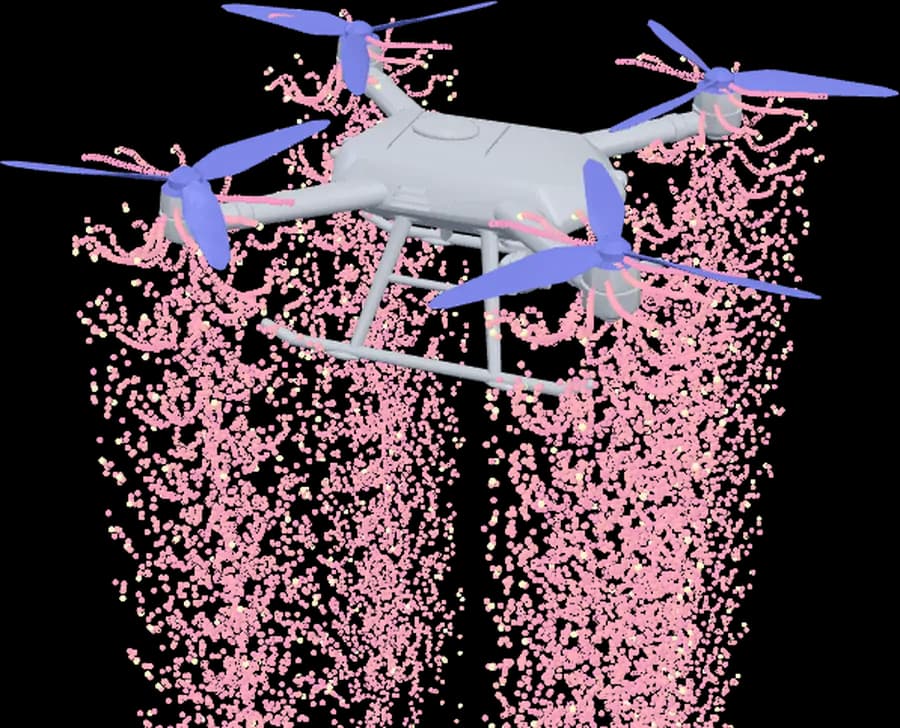
Toggle the body, rotor lattice and wakes to explore the 3D view.
Questions and answers
Can KV alone determine the required motor?
No. KV relates rotational speed to voltage. Thrust depends on the propeller and operating conditions; use test data for the complete combination.
Can I select an ESC directly from the calculator result?
The calculator’s current and ESC values are based on estimated hover power. They are not measured current at the target thrust. Use the selected combination’s measured current and operating ratings for hardware selection.